Pull up the West End's neighborhood page on any major listing site right now and you'll see something that looks like a warning sign: average sale price down 47.1 percent in the past year, landing at $713,000 last month. Anyone who owns a home there, or is trying to buy one, would read that as bad news. Meanwhile, walk fifteen minutes east to Munjoy Hill and the story flips. Search the Hill's active listings and the average price across the handful for sale right now runs north of $2.2 million.
Put those two numbers side by side and you'd conclude that Portland's peninsula split into a discount half and a luxury half sometime in the last twelve months. That conclusion is wrong, and the same data that produced the scary headline also explains why.
What the Average Actually Measures
An average sale price does not track what any single home is worth over time. It tracks what happened to sell during a given window, and that mix changes constantly. If a neighborhood's June included more modest condos and fewer sprawling single-family sales than the June before it, the average will drop even if every individual home held its value or gained.
That's the mechanism sitting inside the West End's number. Look past the average to the median, which is less swayed by a handful of extreme sales, and the story reverses. Over the three months ending in June 2026, the West End's median sale price was $707,000, up 8.9 percent from the same stretch a year earlier. Homes also moved faster: 37 days on market on average, down from 68 days the year before, with 23 homes sold in June versus 18 the prior June.
Taken together, the figures show why a neighborhood-wide average is a poor guide to an individual home’s value. Neither the average nor the median alone tells a buyer what a specific home should cost.
The Range Sitting Inside One Zip Code
The reason the average swings so hard becomes obvious once you look at what's actually moving through the West End right now, because the range of condition is unusually wide even for a historic district.
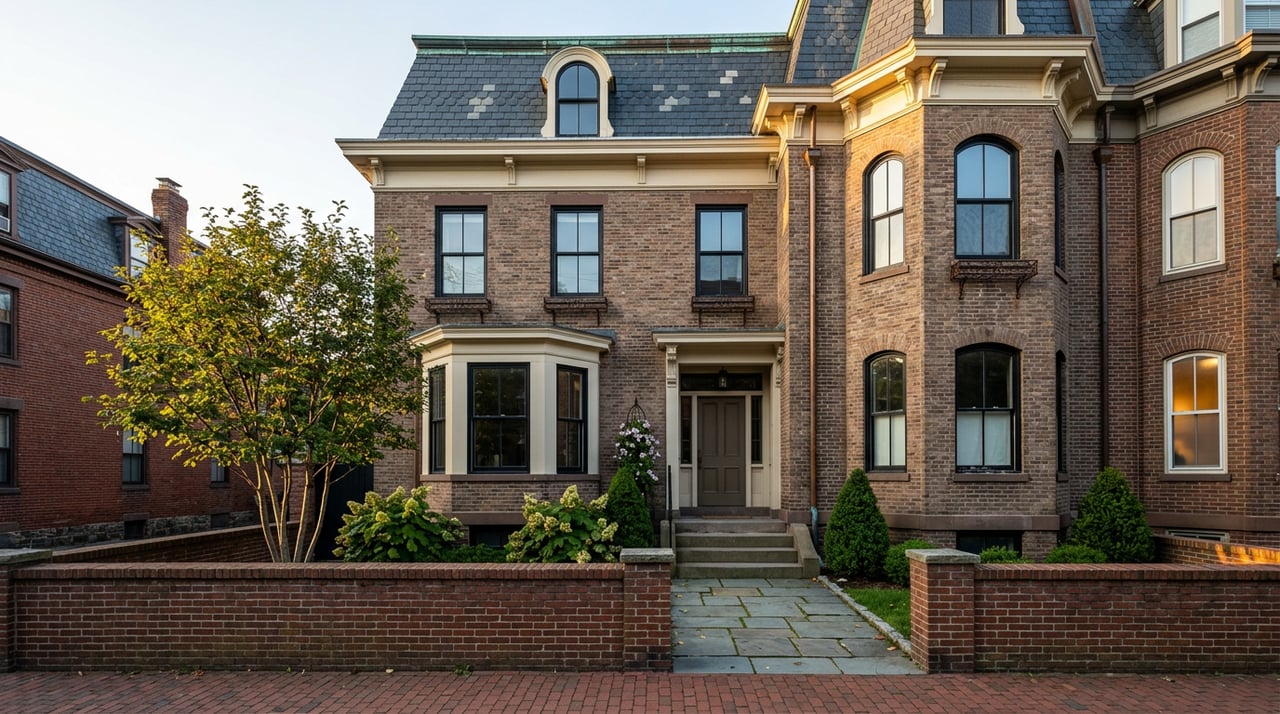
At one end sits a home like the Samuel Spring House, an 1855 residence designed by architect Charles A. Alexander and owned by the same family since 1965. It carries over 6,000 square feet of largely untouched original detail, from plaster medallions to gas chandeliers converted to electric, and it's been featured this year in Portland Magazine's Summer 2026 "Talking Walls" column as a piece of the city's architectural record. A house like that sells for what it is: a restoration project, priced well below what a fully updated Victorian of the same size commands, because the buyer is pricing in the work still ahead.
At the other end is a newly built West End residence finished this year with Therma-Steel insulated panels, Marvin windows, Boral cementitious siding, and a custom kitchen completed in 2026. It's built on the same peninsula, under the same historic-district rules, but it trades at new-construction pricing with none of the deferred maintenance.
When both of those homes count toward the same neighborhood average in the same season, the number tells you almost nothing about appreciation. It tells you which end of the condition spectrum happened to close escrow that month.
Munjoy Hill's Version of the Same Trick
Munjoy Hill's headline number has a different cause but the same effect. The Hill's current active listing pool is thin, and at last count ran to just eight homes for sale, averaging $2,276,113 with an average size of 2,514 square feet against a county average closer to 2,055. A sample that small gets pulled hard by whatever happens to be listed, and right now that includes architect-designed condo conversions like 60 Munjoy Street, an 1895 building converted by Caleb Johnson Architect + Builders into designer units with private porches and parking.
Here's the detail that actually settles the question of whether the Hill is genuinely pricier than the West End: when Redfin pulled comparable sales to estimate the value of one Munjoy Street unit, it used six comparable homes with an average sale price of $712,000. Not $2.2 million. Seven hundred and twelve thousand dollars, a figure that lands inside a few thousand dollars of the West End's median.
That's the real number underneath both neighborhoods' noisy headlines. The West End and Munjoy Hill are trading at comparable levels for a typical home this year. The visible gap between them is a listing-mix illusion, produced by the fact that Munjoy Hill's current for-sale inventory happens to be small and skewed toward luxury conversions, while the West End's June included a broader run of ordinary sales.
Side by Side
| West End | Munjoy Hill | |
|---|---|---|
| Median trade price (3 months through June 2026) | $707,000 | Not separately reported; comparable-sales set for one active listing averaged $712,000 |
| Average price | Sale-price average: $713,000 (last month) | Active-listing average: $2,276,113 across 8 listings |
| Days on market | 37, down from 68 a year earlier | Not separately reported |
| What's actually for sale | Everything from an 1855 unrestored mansion to a 2026 custom-built infill home | A small batch of architect-converted luxury condos |
What This Means If You're Comparing the Two
Neither neighborhood got cheaper and neither got dramatically more expensive. Portland's peninsula as a whole stayed competitive through the spring, with the city scoring 79 out of 100 on Redfin's compete index, homes fielding three offers on average, and a citywide median of $607,000 over the three months ending in May 2026, up 5.8 percent year over year. That's the backdrop both the West End and Munjoy Hill are operating inside.
If you're deciding between them, the neighborhood-level average is close to useless for budgeting purposes this year. What matters is the specific type of home you want and what its true comparables are trading for, not what happens to be sitting on the active listing page. A renovated Victorian condo in the West End and an architect-converted unit on Munjoy Hill may be closer in price than either neighborhood's reputation suggests. A restoration project like the Samuel Spring House will price differently from a move-in-ready home on the same street, regardless of which side of the peninsula it sits on.
The practical move is to ask for a comparable-sales pull on the exact type of property you're considering, not the neighborhood's rolling average, before you let a headline number set your expectations.
A Few Direct Questions
Why did the West End's average price "fall" 47 percent if homes are selling faster than last year? Because the average reflects which homes sold, not how much value any one home gained or lost. Faster sales and a rising median in the same window point to a healthy market for typical homes even while the average swings on mix.
Is Munjoy Hill actually three times more expensive than the West End? Not based on comparable sales. The Hill's active-listing average is skewed by a small pool of luxury conversions. The comparable-sales set behind at least one recent Munjoy Hill listing averaged $712,000, essentially matching the West End's median.
What should I actually compare if I'm choosing between these neighborhoods? Pull recent sales for the specific property type you want, condo versus single-family, renovated versus project, rather than relying on the neighborhood's overall average or median for a given month.
Numbers like these are exactly why a market snapshot only tells half the story. If you're weighing the West End against Munjoy Hill, or trying to figure out what a specific street is really worth right now, the partners at Waypoint Brokers Collective can pull the actual comparables for the home you're considering. Find your better way home.